


RS Intent
At The Telford Langley School, Religious Studies equips students with the knowledge and skills to understand a diverse range of religious and non-religious worldviews, while developing the ability to think critically about ethical and philosophical issues.
Why do we study Religious Studies?
Religion and belief has, and continues to, shape the world in which we live. Just as Geography attempts to understand our natural world. Religious Studies attempts to make sense of the diversity of human beliefs and practices that exist on Planet Earth.
Are we trying to teach students to be religious?
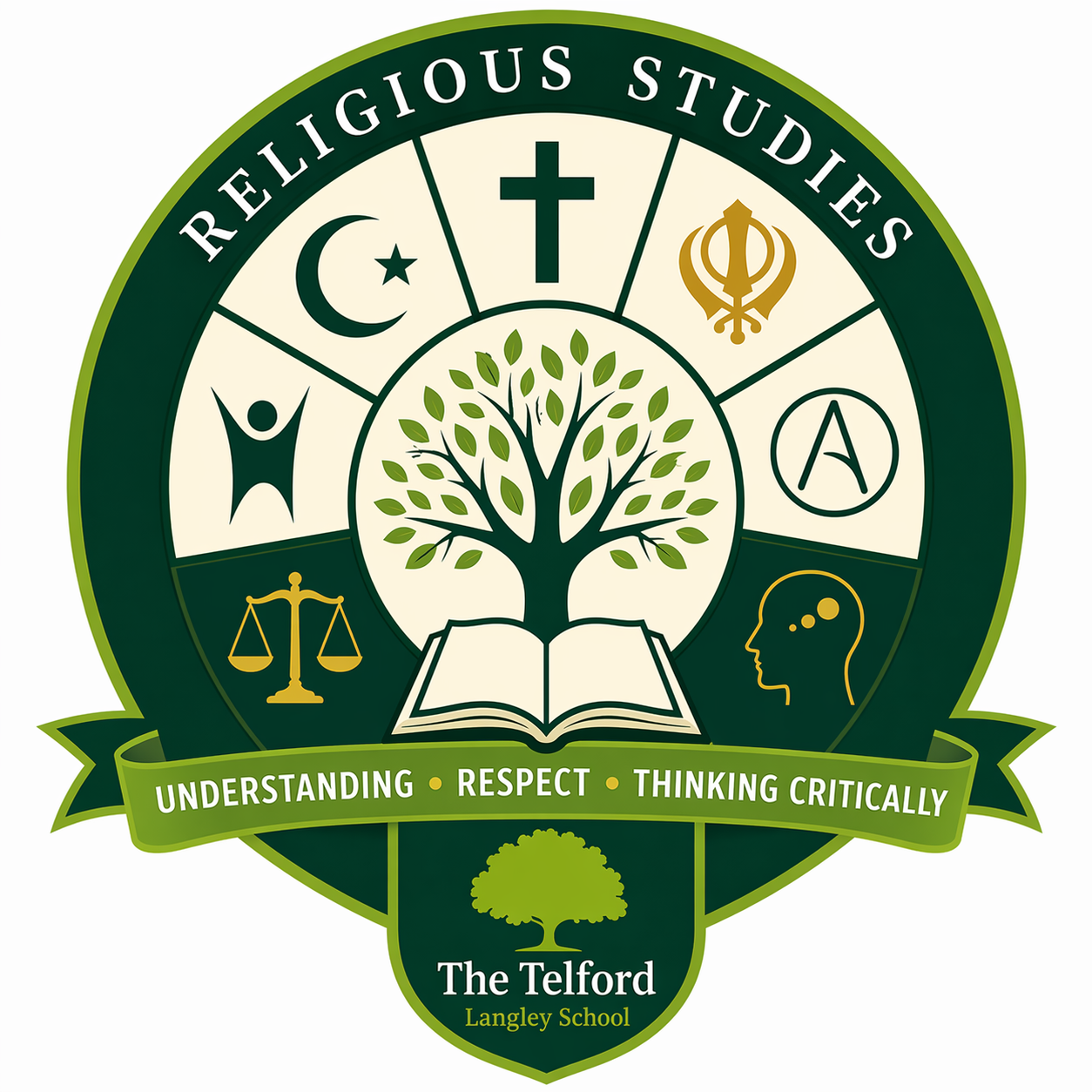
Absolutely not! Religious Studies aims to help students understand the reasons why people believe and do not believe in God. It is a subject that aims to give students the skills to analyse and evaluate fundamental questions by themselves to reach their own conclusions about ethical and philosophical issues. A wide variety of worldviews are taught, including Christianity, Sikhi, Islam, atheism and humanism.
What do we study?
Students explore issues around the key themes of:
¨ Ethics (what actions and decisions are right and wrong)
¨ Philosophy (all about life’s big questions)
¨ Christianity (understanding our countries religious history and traditions, and learning key Christian beliefs)
¨ Islam (what does the world’s fastest growing religion believe and do)
¨ Sikhi (learning about Indian history and an Eastern religion)
Our approach to Religious Studies is centred around two key assessment objectives:
What can we learn about religion and non-belief
What can we learn from religion and non-belief
Can I withdraw my child from Religious Studies?
Any parent of a pupil has the right to remove their child from all or part of the religious education (RE) taught curriculum. You do not have to provide a reason for this. If you are considering withdrawing your child from Religious Education, we would be happy to discuss any concerns or questions you may have. This conversation can help ensure you have all the information needed to make a fully informed decision.
Are there any limitations to withdraw?
- If pupils are withdrawn from RS, schools have a duty to supervise them, though not to provide additional teaching. A pupil may be required to work in another area of the school, such as library or House base.
- Whilst parents or carers have a right to withdraw children from RS, it is important to note that children may also encounter religions and beliefs and wider aspects of faith in other areas of the curriculum from which there is no right of withdrawal.
- On occasion, spontaneous questions about religious matters are raised by pupils or issues related to religion arise in other curriculum subjects such as history or in assemblies and there is no right to withdraw from this.
I am thinking of withdrawing my child from Religious Education, how do I this?
Please contact: Annalisa.Parr@telfordlangleyschool.co.uk and inform the curriculum leader for this subject area of your intention.
Key Stage 3 (Years 7–9): Foundations of Belief and Practice
In Key Stage 3, students build a strong foundation by studying the beliefs and practices of major world religions:
-
Year 7 – Christianity
Students explore key Christian beliefs, teachings, and practices, including the nature of God, the life of Jesus, and how Christians live out their faith today. -
Year 8 – Sikhism
Students learn about Sikh beliefs, including equality and service, as well as key practices such as worship, the Gurdwara, and the importance of the Guru Granth Sahib. -
Year 9 – Islam
Students study Islamic beliefs, including the nature of Allah and the importance of the Prophet Muhammad, alongside practices such as the Five Pillars of Islam.
Across Key Stage 3, the focus is on developing knowledge, understanding, and respect by learning both about and from religious traditions.
Key Stage 4 (Years 10–11): Applying Knowledge to Big Questions
At Key Stage 4, students build on their knowledge of religion to explore ethical and philosophical issues. Students examine major questions and debates such as:
- Abortion
- Euthanasia
- The nature of life and death
- Moral decision-making
Students are encouraged to:
- Apply religious teachings to contemporary issues
- Evaluate different viewpoints
- Develop reasoned arguments
Alongside religious perspectives, students also explore atheist and humanist viewpoints, ensuring a balanced understanding of both religious and non-religious responses to ethical questions.
A. Parr - Head of RSHE