Please select a subject from the list to explore our curriculum and discover the wide range of opportunities available at The Telford Langley School.
You will also find links to our learning journeys, which outline the planned curriculum for each subject across all year groups.
If you require any further information about our curriculum or its content, please do not hesitate to contact us. We will be happy to answer any questions you may have.
Unlocking Language
The Importance of Subject‑Specific Language
Developing a secure and rich vocabulary is central to pupils’ success across the curriculum. Learning the language unique to each subject enables pupils to access knowledge, think deeply, and communicate ideas with precision. Subjects such as science, mathematics, history, and design and technology each have their own specialist vocabulary, structures, and ways of expressing meaning.
The Curriculum and Assessment Review (2025) emphasises that knowledge is built cumulatively and that language is a key vehicle through which pupils make sense of new learning. Similarly, the Ofsted Education Inspection Framework highlights the importance of disciplinary literacy, recognising that pupils need to learn how language is used differently across subjects in order to understand, remember, and apply what they have been taught.
Without a secure understanding of subject‑specific vocabulary, pupils may struggle to fully engage with learning or demonstrate what they know. Explicit teaching of vocabulary supports comprehension, reduces cognitive load, and enables pupils to access increasingly complex concepts as they progress through school.
To support this, we have published a subject vocabulary guide, including frequently used words and key terminology for each discipline.
Our Approach to Vocabulary Development
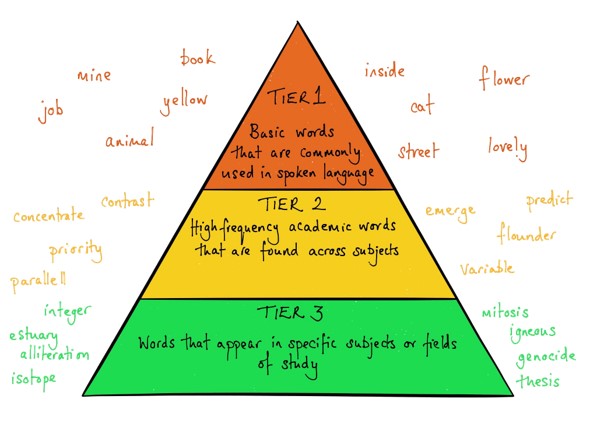
We organise vocabulary teaching using a widely recognised three‑tier model, which supports pupils to move from everyday language to subject‑specific expertise.
Tier 1 Vocabulary – Everyday Language
Tier 1 words are common, everyday words that pupils usually acquire naturally through speaking and listening. These words typically have simple meanings and are used across many contexts.
Examples include: dog, happy, run
While these words generally require less direct teaching, ensuring pupils fully understand them is essential, particularly for pupils with language gaps or for whom English is an additional language.
Tier 2 Vocabulary – Academic Language
Tier 2 words are high‑utility academic words that appear frequently across subjects and are essential for reading, writing, and thinking at a higher level. These words are not always used in everyday conversation and therefore benefit from explicit teaching.
Examples include: analyse, evaluate, predict
Research shows that strong Tier 2 vocabulary significantly improves pupils’ comprehension and ability to engage with challenging texts. Ofsted recognises this academic language as a key driver of success across the curriculum.
Tier 3 Vocabulary – Subject‑Specific Language
Tier 3 words are specialised terms that are unique to particular subjects or disciplines. These words are often technical and specific to a topic being studied.
Examples include: photosynthesis, isotope, equation
Explicit teaching of Tier 3 vocabulary is essential for pupils to understand key concepts, participate in subject‑specific discussions, and develop expertise within each discipline.
Why This Matters
By systematically teaching vocabulary across all subjects, we ensure that pupils:
- Can access the full curriculum
- Develop confidence and fluency in subject‑specific language
- Build knowledge securely over time
- Are well prepared for future learning and assessment
This approach reflects national expectations and research‑informed practice, ensuring that language supports learning rather than acting as a barrier.